


5 Warning Signs! Is It Time to Replace the Laser Diode in Your Particle Counter?
For high-precision instruments like Airborne Particle Counters, the most critical component is the “Laser Diode”. It acts as the “eye” that detects millions of microscopic particles in the air.
But did you know that Laser Diodes have a lifespan? Typically, they last about 20,000 – 40,000 operating hours (or roughly 3-5 years of heavy use). When the laser deteriorates, counting efficiency drops immediately, making measurement results unreliable. Worst of all, it leads to “Calibration Failure.”
Today, Volchatex Engineering guides you through 5 warning signs that indicate your device needs a “heart transplant.”
1. Counting Efficiency Below Standard (Most Common)
This is the clearest symptom and the main reason for failing ISO 21501-4 calibration.
When the Laser Diode weakens, light intensity drops, causing the device to become “blind” to small particles (e.g., 0.3 or 0.5 µm). Consequently, the Counting Efficiency, which should be 50% ± 20%, plummets to 20-30% or lower. If your calibration report shows a drop in efficiency (especially at the smallest channel), this is your first red flag.
2. Abnormally Low Particle Counts
Try placing the suspect unit side-by-side with a Reference Instrument or a new unit in the same location and run a test. If your old unit reads significantly lower than the new one (e.g., the new unit reads 10,000 particles, but the old one reads only 6,000), there is a high chance the laser is too weak to detect all particles.
3. “Laser Status” or “Sensor Error” Alerts
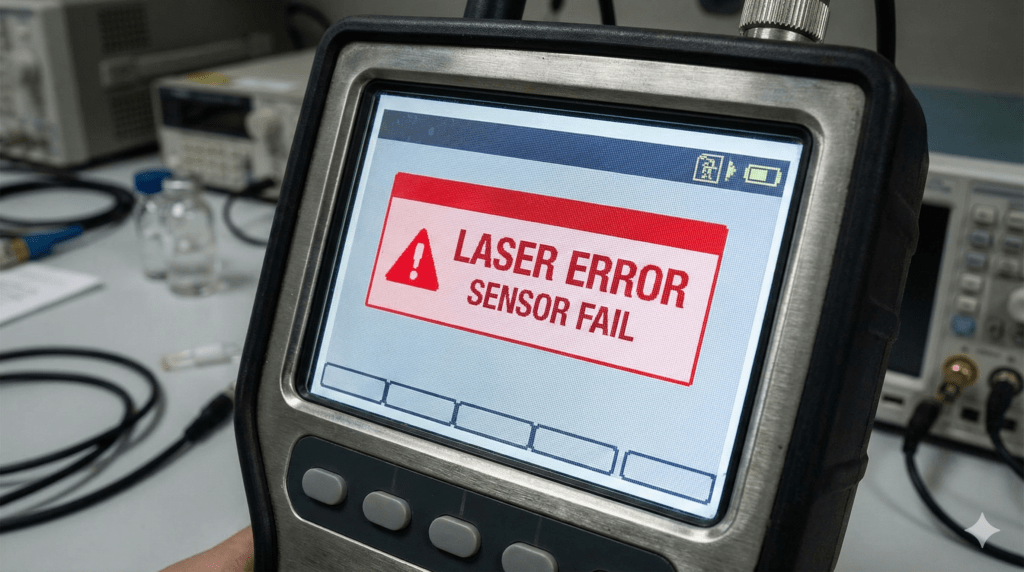
Modern or high-end models often have Self-Diagnostic systems. If the screen displays Error Codes related to Laser Current High or if the Laser status light turns red/orange, it means the circuit is maximizing current to drive a dying laser. You should replace it immediately before the circuit board burns out.
4. Usage Age Exceeds 5-7 Years
Even with good maintenance, electronic components degrade over time. If your device has been in use for over 5 years and starts acting up, replacing the Laser Diode is like resetting the sensor’s lifespan, allowing it to be used for many more years.
5. Adjustment Is No Longer Possible
During calibration, technicians can usually adjust Gain or Threshold values to compensate for deviations. However, if the Laser Diode has deteriorated to its limit, no amount of adjustment will bring the values back within standard range (Dead Sensor). In this case, replacement is the only option.
Good News: You Don’t Need to Buy a New Machine!
Many customers are shocked when service centers say, “Sensor failed, you need to buy a new machine,” which can cost 50-80% of the original price.
At Volchatex Engineering, we offer a smarter alternative:
-
Cost Saving: Laser Diode replacement is significantly cheaper than buying a new unit.
-
High-Quality Parts: We use Industrial Grade Laser Diodes with long lifespans.
-
One-Stop Service: After replacement, we immediately perform Re-Calibration to confirm the unit passes ISO 21501-4 standards and issue a valid Certificate.
-
Multi-Brand Support: We have expert engineers ready to service various brands.
Conclusion
Don’t let a deteriorated laser compromise your cleanroom reports. If your particle counter shows any of these 5 signs, don’t throw it away! Send it to us for a free assessment.