



How to Choose a Particle Counter Calibration Lab to Pass Audit 100%? (User & Purchasing Guide)
Have you ever faced this problem? You send your instrument for calibration, receive the certificate, but on audit day, the auditor rejects it, saying “This certificate is invalid” or “The standard does not meet the requirements.”
This issue doesn’t just cause embarrassment; it means spending money on recalibration or, worse, putting your production line’s credibility at risk.
Today, Volchatex Engineering shares 4 essential checklists for choosing a Calibration Lab for Airborne Particle Counters to ensure that once you pay, the job is done—and you pass your audit with flying colors.

1. Must Be ISO/IEC 17025 Accredited (Check the Logo)
Anyone can claim to follow “ISO standards,” but for calibration, the only proof of competence is ISO/IEC 17025 accreditation.
How to check: On the certificate or the lab’s website, look for the logo of an Accreditation Body (AB) such as ANAB, TISI (TIS), or DSS, along with a specific accreditation number. This confirms the lab operates under a globally recognized quality system.
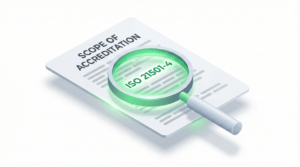
2. The “Scope” Matters More Than the Certificate
This is the most common “trap” for user and purchasing teams!
Just because a lab has ISO 17025 doesn’t mean they can calibrate everything. Some labs are accredited for Temperature or Scales but “do not have the scope for Particle Counters.”
What to look for in the Scope:
-
It must explicitly list Airborne Particle Counter.
-
It must reference ISO 21501-4 (the current standard), not obsolete ones.
-
It must cover the particle sizes you use (e.g., 0.3, 0.5, 1.0, 5.0 µm).
At Volchatex, we are ISO/IEC 17025:2017 accredited specifically for the ISO 21501-4 scope, ensuring your specs satisfy any auditor.
3. Repair & Adjustment Capability (One-Stop Service)
Measurement tools aren’t just about getting a sticker. What happens if you send it in and the result is “Fail”?
-
General Labs: They return the unit with a “Fail” certificate. (You waste money on calibration and still need to find a repair shop).
-
Volchatex Engineering: We are both a Lab and a Technical Service Center. If the values are out of spec, we can Replace the Laser Diode or perform adjustments immediately to bring it back within standard—all in one place.
This saves you time and eliminates the need for multiple purchase orders.
4. Clear Turnaround Time
In manufacturing, “time is money.” Leaving your instrument at a lab for 1-2 months can disrupt production. You should choose a lab with a clear turnaround time and an advance booking system.
Summary: Don’t Just Look at Price, Look for “Peace of Mind”
Choosing a quality calibration lab isn’t about finding the cheapest option; it’s about finding a partner that helps you “sleep well” the night before an audit.
At Volchatex Engineering, we understand the needs of industrial clients. With our expertise in particle counters, we are ready to ensure your instruments are always audit-ready.