


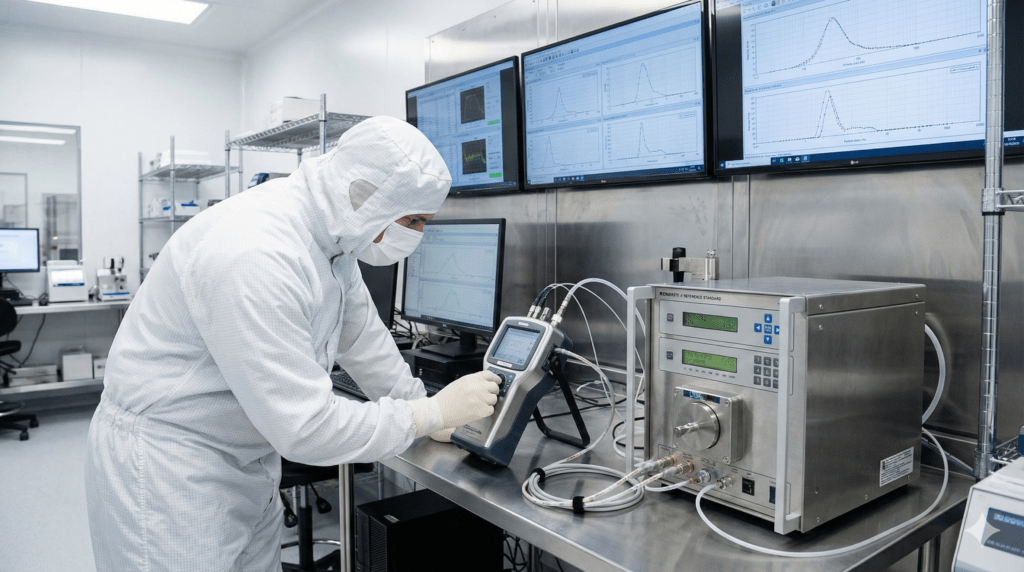
Why ISO 21501-4 Calibration Matters for Your Particle Counter? (A Simple Guide)
Have you ever faced this question from an auditor? “Is your calibration certificate compliant with ISO 21501-4?”
If you work in strictly controlled environments like Pharmaceutical manufacturing (GMP/PICs), Electronics (Semiconductor), or Hospitals, relying on old calibration standards for your Airborne Particle Counter might no longer be sufficient to pass your audit.
In this article, Volchatex Engineering explains why ISO 21501-4 has become the global standard and how it safeguards your production line from compliance risks.
What is ISO 21501-4?
ISO 21501-4 is the specific international standard for “Light Scattering Airborne Particle Counters (LSAPC).” Its primary goal is to minimize unit-to-unit variation, ensuring that different instruments from different brands yield consistent measurement results.
In the past, standards like JIS B 9921 or ASTM F328-98 were common. However, these older standards had loopholes regarding accuracy verification. ISO 21501-4 was established to close these gaps and ensure higher reliability.
3 Key Parameters That Make ISO 21501-4 “Stricter”
To ensure your instrument is truly accurate, this standard rigorously checks the following:
1. Counting Efficiency
2. Sizing Resolution
3. False Count Rate
Who “Needs” to Comply with This Standard?
If your business falls into these categories, referencing ISO 21501-4 is virtually mandatory:
-
Cleanroom ISO Class 5 or higher: e.g., HDD, Wafer, Semiconductor industries.
-
Pharmaceutical Industry: Manufacturing of drugs and vaccines (GMP/PICs compliance).
-
Medical Devices: Sterile medical equipment production.
Calibration Failed? Do You Need to Buy a New Machine?
The answer is “No”, and this is where Volchatex stands out.
Many customers face a situation where their device fails calibration elsewhere and are advised to buy a new unit costing thousands of dollars. At Volchatex, we specialize in Technical Services.
If your device fails due to low Counting Efficiency or a weak Laser:
-
We provide high-quality Laser Diode Replacement.
-
We perform internal Circuit Adjustment.
-
We Re-Calibrate the unit until it passes ISO 21501-4 standards.
This solution helps you save a significant budget compared to purchasing a new instrument.
Conclusion: Choose Confidence, Choose Volchatex
Calibration is not just about getting a sticker; it is about verifying your production quality. At Volchatex Engineering, we operate an ISO/IEC 17025 Accredited Laboratory specifically for the ISO 21501-4 scope, staffed by engineers who can maintain your equipment down to the component level.
Don’t let your measurement instruments be the weak link in your quality system.